A practical development environment for turning algae biology into controlled cultivation, measurable process evidence, usable biomass, and downstream products.
An algae culture can grow and still fail as a process. A strain can be interesting and still fail as a product. A waste stream can contain useful nutrients and still be too variable to operate reliably.
The Foundry exists to work across those gaps. It connects organism behavior, cultivation conditions, inputs, sensing, biomass handling, downstream use, and the evidence needed to decide what happens next.
The Foundry treats the biological system as a chain. Each stage has its own uncertainty, measurements, and failure modes—and each stage affects the one after it.
Physiology, strain behavior, growth limits, and useful traits.
Water, nutrients, carbon, light, side streams, and environmental conditions.
Controlled operation, productivity, stability, and repeatability.
Sampling, sensors, analytics, and decision-quality process evidence.
Harvesting, composition, downstream handling, formulation, or application.
Culture operation, media strategy, light, carbon, temperature, pH, mixing, and scale-aware photobioreactor workflows.
Designed experiments that isolate the variables that matter and determine whether an observed result is robust enough to act on.
Evaluation and conditioning of nutrient, carbon, water, and side-stream inputs so biological reuse becomes controllable rather than aspirational.
Practical instrumentation, sampling, and analytical workflows that make the process observable and improve operating decisions.
Harvesting, concentration, composition, fractionation, storage, and preparation of biological material for its next use.
Carrying biomass or biological compounds toward agriculture, formulation, product development, or another defined customer outcome.
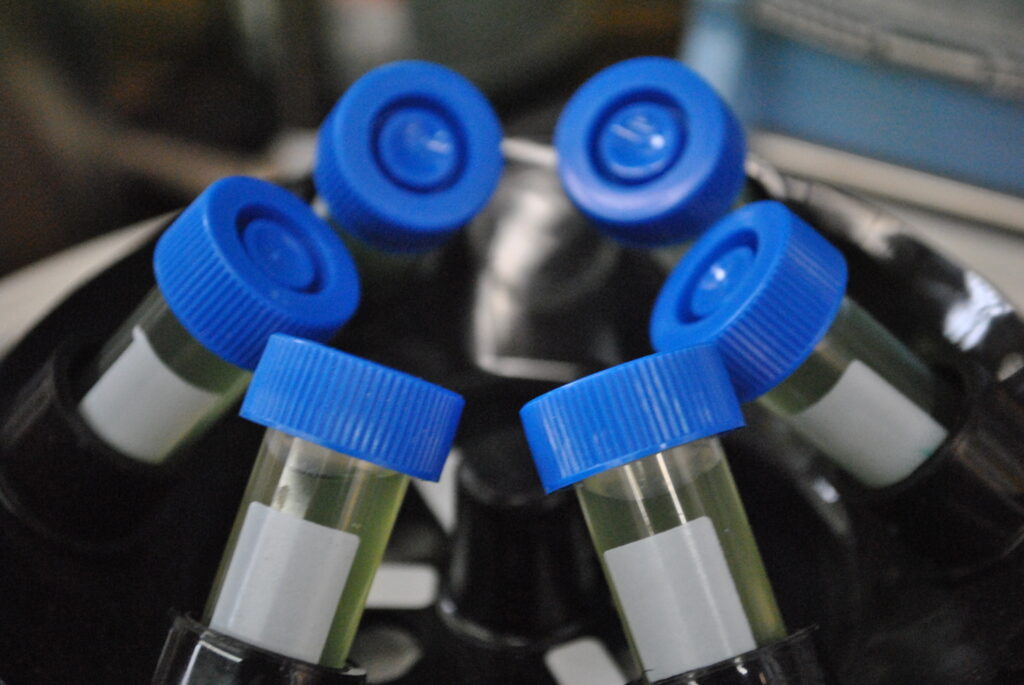
Biomass is not the end point. Its composition, consistency, handling, and intended use determine whether a cultivation process has created something useful.
The Foundry follows material beyond the reactor. Biomass may need to become a stable ingredient, an agricultural input, an analytical sample, a fraction, or evidence for a larger process decision.
That changes how cultivation is evaluated. Yield matters, but so do composition, reproducibility, handling requirements, downstream compatibility, water use, and the value of the final outcome.
Rather than designing a platform in the abstract, Algae Analytics is building Foundry capability through projects that force the cultivation, measurement, resource, and downstream pieces to work together.
Replicated photobioreactor runs across an agreed salinity and water-chemistry range, using project water where practical, to determine whether a strain remains productive and operationally stable before larger pilot investment. Builds on prior hypersaline field research and brine-based cultivation experiments.

Testing how brewery side streams and fermentation CO₂ can become controlled cultivation inputs while tracking productivity, stability, and biomass value.

Connecting operating strategy to biomass yield and composition so optimization reflects the intended outcome, not simply maximum growth.

Building data that can support process choices, partnership decisions, and the next experimental step—not just demonstrate that an effect exists.
The Foundry is most useful when the problem can be expressed as a decision that cannot yet be made with confidence.
Clarify what needs to be known, what outcome matters, and which unknowns are actually preventing progress.
Design the cultivation, measurement, or downstream work needed to isolate those unknowns.
Return evidence, material, operating insight, or a revised process that makes the next decision possible.
The Foundry is designed for teams with a real biological question, process dependency, material need, or product pathway—not for generic strategy work detached from the system itself.
If the next step depends on understanding how an algae system behaves in the real world, that is a Foundry problem.